














lightning-rod
Turn real-world data into training datasets fast
Lightning Rod Wants to End the Hand-Labeling Nightmare. The Data Might Actually Back That Up.
The Macro: Why the Data Labeling Market is Sleeping on Its Biggest Problem
Everybody wants a domain-expert AI. Nobody wants to talk about what it takes to build one.
The dirty secret is that most of the work isn’t the model architecture or even the compute. It’s the data. Specifically, it’s the several months of labeling, cleaning, validating, and praying that your training set actually reflects the real world and not some intern’s best guess from six months ago. This is the bottleneck that makes enterprise AI projects run eighteen months over schedule.
Here’s my take: the entire upstream data infrastructure market is misdirected. The AI developer tools market was valued at around $4.5 billion and is projected to hit $10 billion by 2030, according to Virtue Market Research. That’s a lot of money flowing into tooling. But most of it goes toward inference, orchestration, and deployment. The messy upstream problem of actually constructing good training data gets surprisingly little love from the VC-backed tooling crowd. This is backwards. You can optimize deployment all you want, but garbage data in means garbage model out. The timing is right for someone to build the canonical solution here, and the fact that nobody has yet tells you everything about how unglamorous the problem feels.
Where data work does get attention, you mostly see two camps. First, synthetic data generators, which are useful but carry a real risk of laundering hallucinations directly into your training pipeline if you’re not careful. Second, human labeling services, which are slow and expensive by definition. Scale AI sits in this space. So does Labelbox. Both are legitimate businesses, but neither is especially friendly to the developer who just wants to spin up a domain-specific classifier over a weekend.
The Micro: A Few Lines of Python, One Less Labeling Sprint
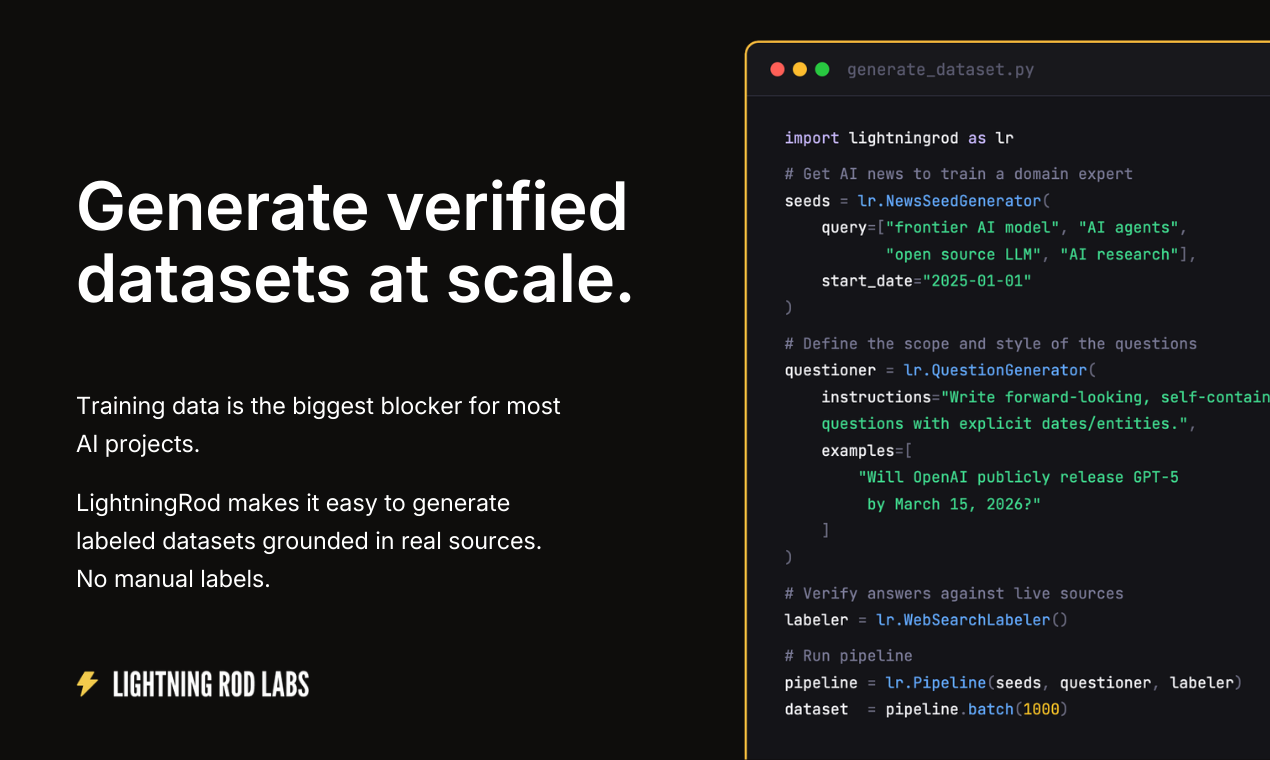
The core idea is straightforward. You point Lightning Rod’s SDK at real-world data sources, things like news articles, SEC filings, regulatory documents, or your own internal document corpus, and it uses verifiable real-world outcomes to generate labels rather than asking a human to assign them manually.
That last part is the genuinely interesting design decision. Instead of synthetic generation or crowdsourced annotation, Lightning Rod anchors its labels to what actually happened. The demo on their site shows a concrete example: a dataset question asking whether the Trump administration would impose 25% tariffs on Canadian goods by a specific date, sourced from a New York Times article, labeled “Yes” with a 0.92 confidence score, with the label sourced from Reuters. The timestamps are right there. The provenance is explicit. That’s a meaningful difference from a synthetic dataset where the “ground truth” is whatever a language model decided felt plausible.
It’s a Python SDK, so setup is minimal. The docs are live at docs.lightningrod.ai and the pitch is that you can get to a production-ready training set in hours rather than weeks.
The customer list on the homepage includes Shore Capital, AirHelp, Brunswick Group, Fabletics, and a few others. That’s a noticeably varied set, spanning finance, consumer, and PR. It suggests the use cases aren’t narrowly vertical, which is either a good sign about generalizability or a warning sign about focus, depending on your read.
It got solid traction when it launched, landing near the top of the daily rankings on Product Hunt.
I’d be curious how the verification layer handles domains where outcomes are ambiguous or delayed. Financial forecasting has relatively clean ground truth. Something like predicting regulatory sentiment or brand perception is messier. The SDK’s reliability probably varies a lot based on how legible the real-world outcome actually is. That’s not a criticism so much as the obvious next question.
For anyone who’s spent time thinking about how AI agents handle messy document pipelines, the upstream data quality problem Lightning Rod is targeting is the same one that tends to quietly degrade everything downstream.
The Verdict: Lightning Rod Will Work, But Only If It Stays Boring
This is going to work. Not maybe, not potentially. Lightning Rod has identified the real problem and built a solution that directly addresses it instead of dancing around it.
The anchoring-to-outcomes approach is the right instinct. Synthetic data is useful but it’s epistemically fragile in a way that real labeled outcomes aren’t. If Lightning Rod can consistently produce datasets with traceable provenance and accurate labels, that’s a legitimate edge over both the labeling services and the generate-and-hope crowd. The confidence scores and source citations in the demo UI aren’t just nice features. They’re the entire company. They’re saying: we know you need to trust this before you deploy it, so we’ve built trustworthiness into the data itself.
The one thing that determines if this company exists in two years is whether they resist the temptation to become a platform. Every data company that got acquired or blew up wanted to be the OS for something. Lightning Rod should want to be the best thing at one specific problem: getting you clean, labeled, production-ready datasets faster than humanly possible. Stay focused on that. Stay unglamorous.
My prediction: they hit 40+ enterprise customers in production by month eighteen, none of them with headlines, all of them shipping models that actually work. That’s the win condition.