














voxtral-tts-by-mistral-ai
Multilingual TTS model with realistic and expressive speech
Mistral Wants to Give Your Voice Agent a Personality
The Macro: Why Everyone’s Betting on Voice AI Before Anyone Actually Wants It
Most AI voice products fall into one of two failure modes. They sound robotic, or they sound uncanny. Neither is acceptable if you’re trying to build a product that people actually use for more than thirty seconds before hanging up.
The demand is real. Voice AI is being bolted onto customer service workflows, sales tooling, language learning apps, healthcare intake forms, you name it. And the companies trying to own that layer, ElevenLabs, PlayHT, OpenAI’s own TTS offering, Cartesia, have all made meaningful progress. But meaningful progress in TTS still often means “good enough to ship, not good enough to trust.”
Here’s what I think most people get wrong about this space: they treat voice as a solved problem in other domains, so they assume it’s close to solved here. It’s not. The underlying technical problem is that generating speech isn’t just pronunciation. It’s interpretation. A line like “oh, great” can mean genuine enthusiasm or complete contempt, and the difference lives in rhythm, intonation, and the half-second pause before the word lands. Most models flatten that. They read text. They don’t perform it.
The market is overhyped on timelines but underselling the real prize. We’re not close to natural voice AI yet, but the companies that crack performative speech, not just phonetic accuracy, will own the layer for a decade. Mistral is a French AI company that has spent the last couple of years positioning itself as the open-weight alternative to the American frontier labs. Their models are generally smaller and faster than comparable offerings from OpenAI or Anthropic, and they’ve built a following among developers who want something they can actually run or fine-tune themselves. That context matters here. Voxtral TTS isn’t Mistral’s first attempt at audio. They had an earlier transcription model under the Voxtral name. This is the TTS branch of that.
The Micro: 4B Parameters, Nine Languages, and a Real Attempt at Emotion
Voxtral TTS is a 4B parameter text-to-speech model. That’s lightweight by modern standards, which Mistral frames as a feature rather than a limitation. Smaller model means lower inference costs and faster response times, both of which matter a lot if you’re running it at scale inside a voice agent pipeline.
The headline capabilities are multilingual support across nine languages with dialect support, low latency for time-to-first-audio (Mistral doesn’t publish a specific number on the product page, but positions it as a core selling point), and what they call voice adaptation. That last one is the interesting part.
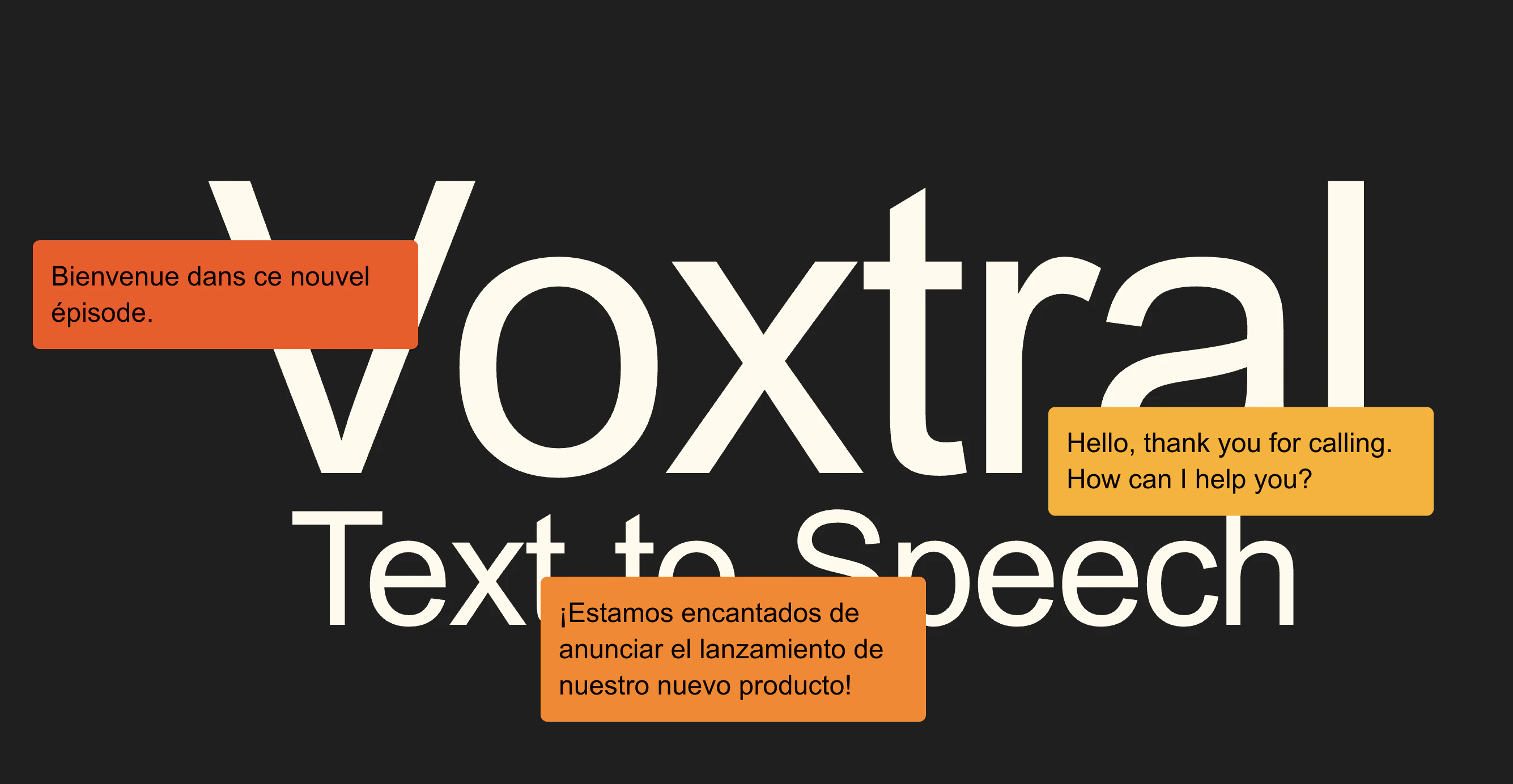
Voice cloning or adaptation in TTS is not new. What Mistral claims to be doing differently is going beyond simple speaker identity matching. According to their product copy, the model tries to capture a speaker’s “personality,” including natural pauses, rhythm, intonation, and what they call “emotional dexterity.” The demo voices on the site include a few presets: Marie in neutral French, Nick in neutral Spanish, Oliver in excited English. Oliver is actually pretty good. The excitement reads as natural rather than performed, which is a harder thing to pull off than it sounds.
The model is available through Mistral Studio for testing, and the open-weight release means developers can pull it directly. According to TechCrunch, it’s open source, which puts it in a different category than ElevenLabs or most of the polished commercial TTS products.
It got solid traction when it launched, which tracks. The developer community around open-weight models is active and moves fast.
For anyone thinking about the infrastructure layer around voice agents, the QA and reliability questions that come with production deployments are real. Someone has already started building in that direction, which tells you something about where the actual pain is right now.
The product targets enterprise voice agent workflows explicitly. That’s a specific enough use case that it either fits or it doesn’t. No ambiguity about who this is for.
The Verdict: Mistral Has the Right Strategy, But Open-Weight TTS Won’t Be the Prize
Mistral is making the smart play, but for the wrong reasons. They’re positioning Voxtral as a developer-friendly alternative to ElevenLabs pricing and OpenAI’s walled garden. That’s defensible. The open-weight TTS space is genuinely thin, and the combination of multilingual support, low latency, and voice cloning in a single 4B parameter package is a reasonable value proposition for developers who don’t want to pay enterprise rates or get locked into closed APIs.
But here’s what actually matters: this company exists in two years if and only if voice adaptation becomes trustworthy enough for real enterprise audio. Not demos. Not curated test sentences. Real customer service scripts with inconsistent punctuation, brand names the model has never seen, and the kind of contextual weirdness that makes enterprise procurement teams nervous.
I think Mistral will ship something that works in controlled environments and then hit a wall. The gap between “works for developers tinkering” and “works for a Fortune 500 contact center” is the gap between nice-to-have and mission-critical, and that’s where the money actually lives. Enterprise TTS buyers don’t care about open-weight. They care about reliability, liability, and not getting sued when the voice agent sounds like it’s mocking a customer.
The real test is whether Mistral can sell into procurement or whether they stay in the developer tier. They have credibility with builders but zero enterprise motion. Anthropic learned this the hard way with Claude Code. Even well-resourced labs find the enterprise-to-developer pivot exhausting.
My prediction: Voxtral becomes a respectable tool for indie builders and gets quietly folded into Mistral’s broader API offerings within 18 months. They’ll make revenue but never the kind that moves the needle for a company their size.