














pio
Agnatically hire, onboard, & pay talent in 150+ countries
PIO Wants to Make Hiring Across Borders Feel Like Sending a Slack Message
The Macro: Why the EOR Market Looks Huge But Feels Broken
The staffing and global hiring market was valued at $620 billion in 2024, according to the Staffing Industry Analysts. That number alone tells you why every VC with a thesis is trying to carve a piece of it.
But here’s what most people get wrong: the market size is a mirage if you’re solving the wrong problem. The actual friction companies face when hiring internationally has almost nothing to do with money and everything to do with process pain. Employment law in Germany works differently than in Brazil. Contractor classification rules in California are not the same as in the UK. If you are a 40-person company trying to hire a great engineer in Indonesia, setting up a local legal entity to do it properly is prohibitively expensive and slow. This is the gap that employer-of-record services, commonly called EOR, are designed to fill.
Deel got here first and raised aggressively. Remote.com followed. Rippling built a platform that extends well beyond international hiring. These are well-funded, well-known products that have spent years competing on geography count, pricing, and compliance coverage.
So the market is not empty. Not even close. But I think most people fundamentally misunderstand what the next generation of winner looks like. It’s not about covering more countries or undercutting pricing by 10 percent. The companies that built Deel and Rippling did so before conversational AI was viable. They optimized for a world where users had to navigate complexity manually. A new entrant that actually redesigns the interaction layer could matter. That is where PIO is making its move. The timing, for once, might actually be right.
The Micro: Ask the AI Where It Costs Less to Hire an Engineer
PIO does the standard EOR things. You can hire in 150-plus countries without setting up entities, run payroll in 120-plus currencies, handle contracts, and stay compliant with local laws. The website lists clients across a range of industries, from consumer electronics names like Xiaomi and OPPO to manufacturing and storage hardware companies. These are real, recognizable brands, which is a meaningful signal for a platform that needs enterprise trust to function.
The product decision I find most interesting is PIO Agent.
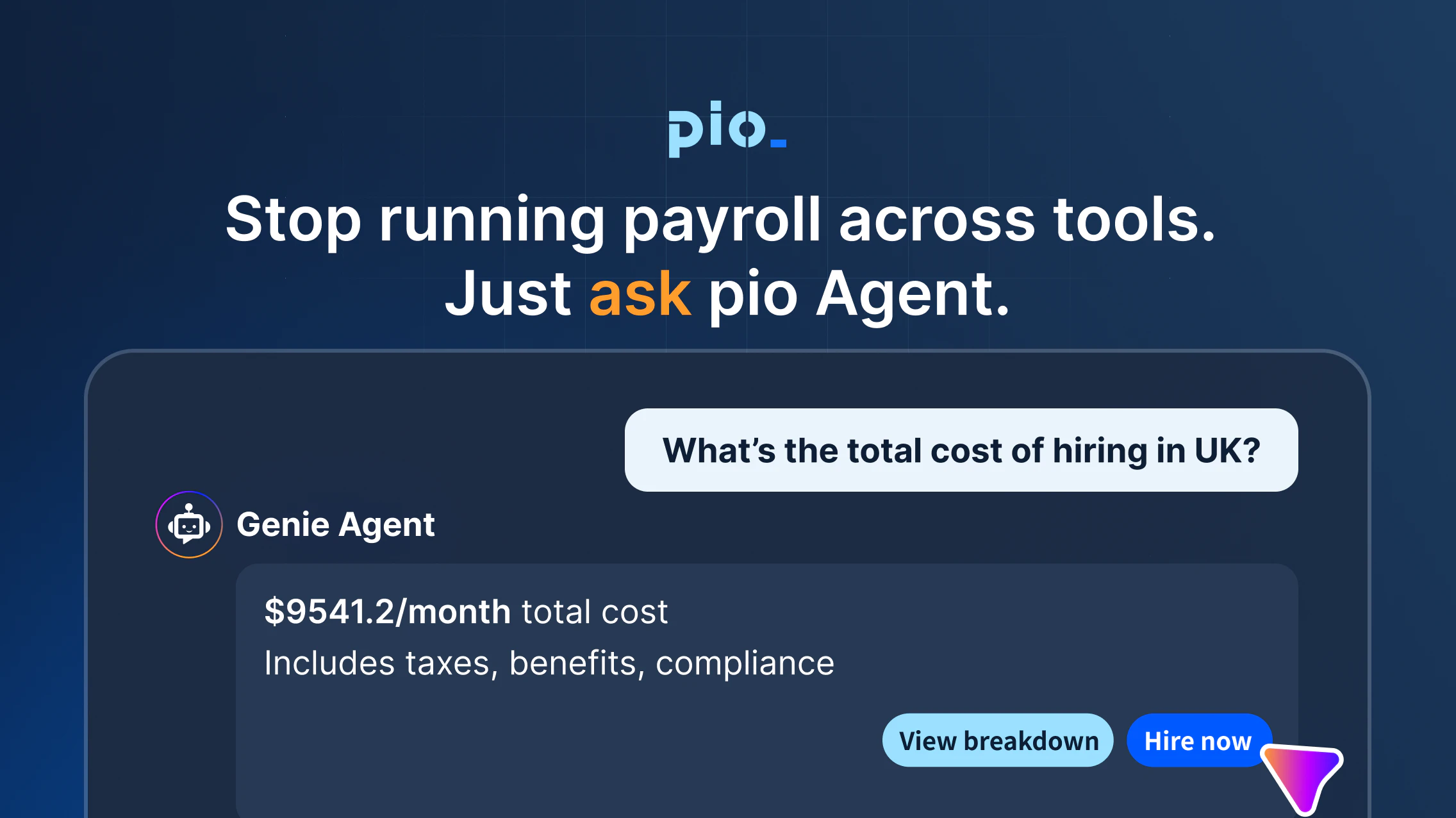
Instead of navigating a dashboard to figure out what it costs to hire a full-time employee in Vietnam versus a contractor in Poland, you ask. The Agent is a conversational layer that sits on top of the payroll and compliance infrastructure. You can reportedly ask it things like the real cost of hiring in a given country, initiate contractor payments, or get EOR details, and then take action from within the same interface. No exporting to a spreadsheet. No chasing down your HR ops person.
This is the right product bet for this moment. The question of whether conversational AI actually reduces friction in enterprise workflows is live and contested. I have watched tools try this and produce interfaces that feel like typing into a search bar that occasionally surprises you. The ambition here is closer to what teams building agentic AI products are chasing, where the AI does not just surface information but actually moves things forward. Whether PIO Agent executes on that or just approximates it is something I could not verify from the outside.
It did well on launch day, picking up solid traction and landing at number five for the day.
The website is clean and direct. Pricing is not listed publicly, which is the standard enterprise move and also the thing that makes me slightly suspicious about who the actual target customer is.
The Verdict: PIO’s Bet on AI as a Moat Could Actually Work
PIO is making a specific and defensible wager: that the interface layer is where the next winner in EOR gets built. I think they’re right about that diagnosis, and the early traction suggests the market agrees.
The client logos are more credible than most startup websites show at this stage. Hardware and manufacturing companies do not take risks on unproven HR infrastructure. If those relationships hold and expand, that tells you something real is happening.
Here’s my actual take: PIO will succeed or fail based entirely on one variable. Not pricing, not geography coverage, not sales execution. It comes down to whether PIO Agent is actually accurate enough to be trusted with compliance decisions. A chatbot that confidently gives you the wrong tax classification in Brazil is exponentially worse than a slow, manual process. The entire value proposition collapses the moment users catch the AI being confidently wrong about something that costs them money.
That’s the bar. Most AI products can ship imperfect and improve iteratively. Payroll compliance cannot work that way. You either get it right or you expose customers to legal and financial liability. Deel and Rippling can afford to be slower because they’ve built institutional trust over years. PIO has zero margin for error on accuracy.
If PIO’s AI is actually reliable at the level required, they’ll own this market within three years. Existing players will struggle to retrofit a conversational model onto their architecture. If the AI is merely good but not flawless, they become an acquihire within 18 months. The shift toward [acts without waiting for permission](/feature/auto-mode-by-claude-cod is coming anyway, but only the accurate version survives.
I’m betting on the former, but I’d want proof before committing capital.