














novi-notes
Local-first AI note app for Mac zero config via MCP
Novi Notes Bets That the Best AI Integration Is the One You Never Had to Configure
The Macro: The Note App Market Is Drowning in False Promises
The productivity software market is genuinely large. According to multiple market research sources, it sits somewhere between $61 billion and $71 billion in 2025, with projections pointing toward $140 to $265 billion by 2034, depending on whose model you trust. The range is embarrassingly wide, but the direction is not in dispute. People are spending serious money on tools that help them think, organize, and remember things.
And yet almost nobody is happy with their note app.
Here’s what I think is happening: the entire category has confused market size with market health. Just because people are spending money doesn’t mean they’re satisfied. The AI note-taking field in particular has developed a reliable pattern: a product arrives promising intelligence, ships a chatbot bolted onto a text editor, and then charges you $15 a month for the privilege. PCMag and Lindy both maintain running lists of the best AI note apps right now, and the categories blur together fast. Notion with AI add-ons. Obsidian with community plugins. Bear for people who want to feel calm. Evernote, which managed to alienate an entire generation of loyal users and is now watching competitors pick through the wreckage. We covered exactly that story when Cimanote launched, and the wound is still fresh for a lot of people.
The honest problem is that most AI features in these apps are decorative. They sit behind a button you click when you remember they exist. The AI is not really part of the workflow. It’s more like a feature you paid for and occasionally feel guilty about not using. What most investors and founders get wrong is that they think the answer to this problem is better AI or more AI or cheaper AI. They’re not paying attention to the actual complaint: users don’t want another AI experience. They want their existing AI to actually work inside the tools they already think in. What the current wave of MCP-enabled tools is starting to suggest is that the real differentiation isn’t smarter, it’s invisible.
The Micro: Install It Once and Then Just Talk
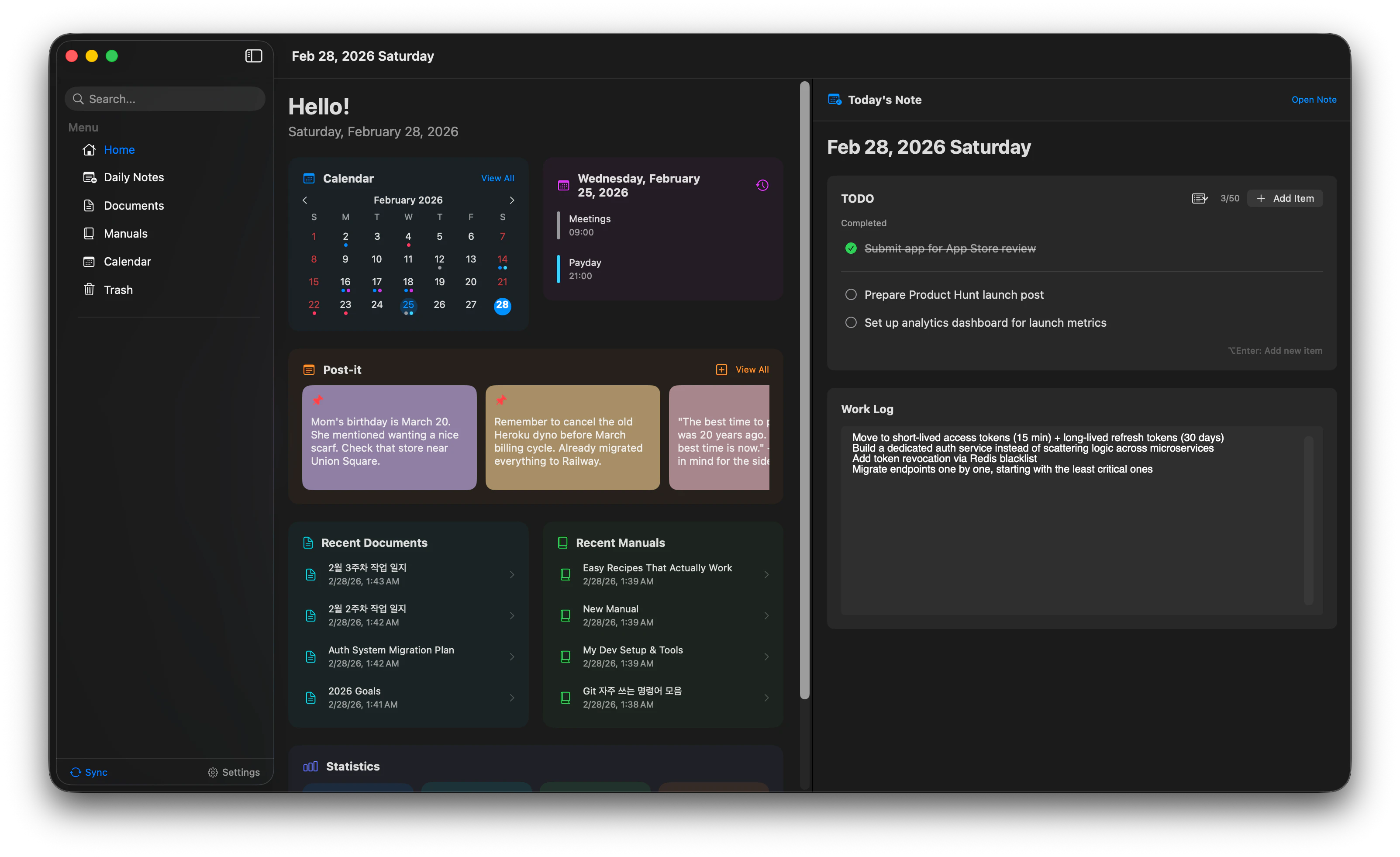
Novi Notes is a Mac note app built by an indie developer in Seoul. The core pitch is this: it’s local-first, fully offline, one-time purchase, and it integrates with Claude via MCP without requiring any configuration from you. No API keys. No plugin setup. No settings panel you have to navigate before anything works. You install the app, open Claude, and Claude can read and write your notes directly.
That last sentence is doing more work than it looks like.
Most AI integrations require you to export something, paste something, or at minimum open a sidebar. The MCP approach means Claude has access to your notes as a native context. You can ask it to find something you wrote last Tuesday, summarize your project notes, or draft a new entry, and it just does it. The notes stay on your machine. Nothing goes to a server. The AI capability comes entirely from whichever Claude interface you’re already using.
The app itself covers a reasonable surface area: daily notes, longer-form manuals, quick post-its, and a calendar view. These are not exotic features. What makes the product decision interesting is what’s not there. No web app. No mobile sync. No subscription tier. A one-time purchase, full stop. That is a genuine position in a market where subscription fatigue is real and most indie developers still default to monthly pricing because the numbers look better on a pitch deck.
It got solid traction when it launched, landing in the top ten for its category on launch day.
The bet Novi Notes is making is that a meaningful slice of Mac users want something that works with the AI tool they already pay for, doesn’t touch the cloud, and doesn’t come with a recurring invoice. That’s a narrower target than “everyone who takes notes,” but narrower targets are sometimes the honest ones.
The Verdict: Novi Notes Is Betting on the Right Problem But Built on Shaky Ground
I think Novi Notes is genuinely interesting, and I think it will either become a template for how indie tools should approach AI integration or become a cautionary tale about platform dependency. There’s no middle ground here.
The MCP integration is the entire product story. If you already use Claude, this removes a real friction point that nobody else has bothered to solve properly. Local-first and one-time purchase are positions I respect because they require the developer to actually believe in something other than churn math. The Seoul indie dev building this isn’t trying to be the next Notion. That clarity matters.
But here’s what keeps me up: the differentiation is entirely borrowed. Novi Notes’ whole value proposition lives inside Claude’s MCP implementation. If Anthropic changes how MCP works, or if OpenAI’s o1 or some other model gets mainstream traction and people migrate their primary AI interaction there, the integration advantage doesn’t just diminish. It evaporates. The app still functions as a note app, sure. But the reason anyone chose it over Obsidian or Bear disappears overnight.
The one thing that determines whether this company exists in two years is whether users actually adopt Claude as their primary AI interface, or whether they stay promiscuous across models. If Claude becomes table stakes, Novi Notes works. If the AI landscape stays fragmented, this is a beautiful product with a six-month shelf life.
My prediction: Novi Notes gains a loyal 15,000-user base in the next 18 months, then hits a growth wall hard. The smart move for the developer is to get acquired by Anthropic before the market figures out that MCP-first positioning is a liability, not a strength.