














clico
Every textbox, supercharged
Clico Doesn't Want You to Leave the Page. That's the Whole Bet.
The Macro: Why the Browser-as-OS Trend Is Real, but the Extensions Gold Rush Is Already Overcrowded
Most people do most of their work inside Chrome. Not in native apps, not in dedicated software suites. In tabs. Google Docs, Gmail, Notion, Slack in a pinch. The browser became the default operating layer for knowledge work quietly and completely, and the tools built around it have been slow to catch up.
The numbers back this up. The Chrome extension market hit $7.8 billion in 2024, up 23% year-over-year according to Forbes. A separate market report from HTF pegs the broader Chrome extensions segment at $2.5 billion currently, projecting growth to $5 billion by 2033. The AI-specific slice is moving faster. According to Dataintelo, the AI Chrome extension market is projected to grow from $1.5 billion in 2023 to $8.2 billion by 2032. The numbers vary by source and methodology, but the direction is consistent: people want AI closer to where they already are.
Chrome itself commands roughly 67.7% of the global browser market as of 2025, according to Backlinko. That’s the install base. Anyone building a browser-native AI tool has an enormous addressable surface before they’ve done a single thing.
Here’s what I think most people get wrong: they see those market projections and assume the winners are already obvious. They’re not. The crowded part is real. Voilà is already here. Copymatic. A long list of tools that attach themselves to the browser and promise to help you write. I’ve covered adjacent products before, including TexTab’s approach to keeping AI at your fingertips without tab-switching and Voicr’s attempt to bridge the gap between thought and typed word. The extensions market is less a gold rush and more a land grab where the land keeps shrinking.
The Micro: One Shortcut, Anywhere You Type
Clico is a free Chrome extension. No API key required, which removes one of the most common early drop-off points for this category of tool. You install it, and it lives inside your browser from that point forward.
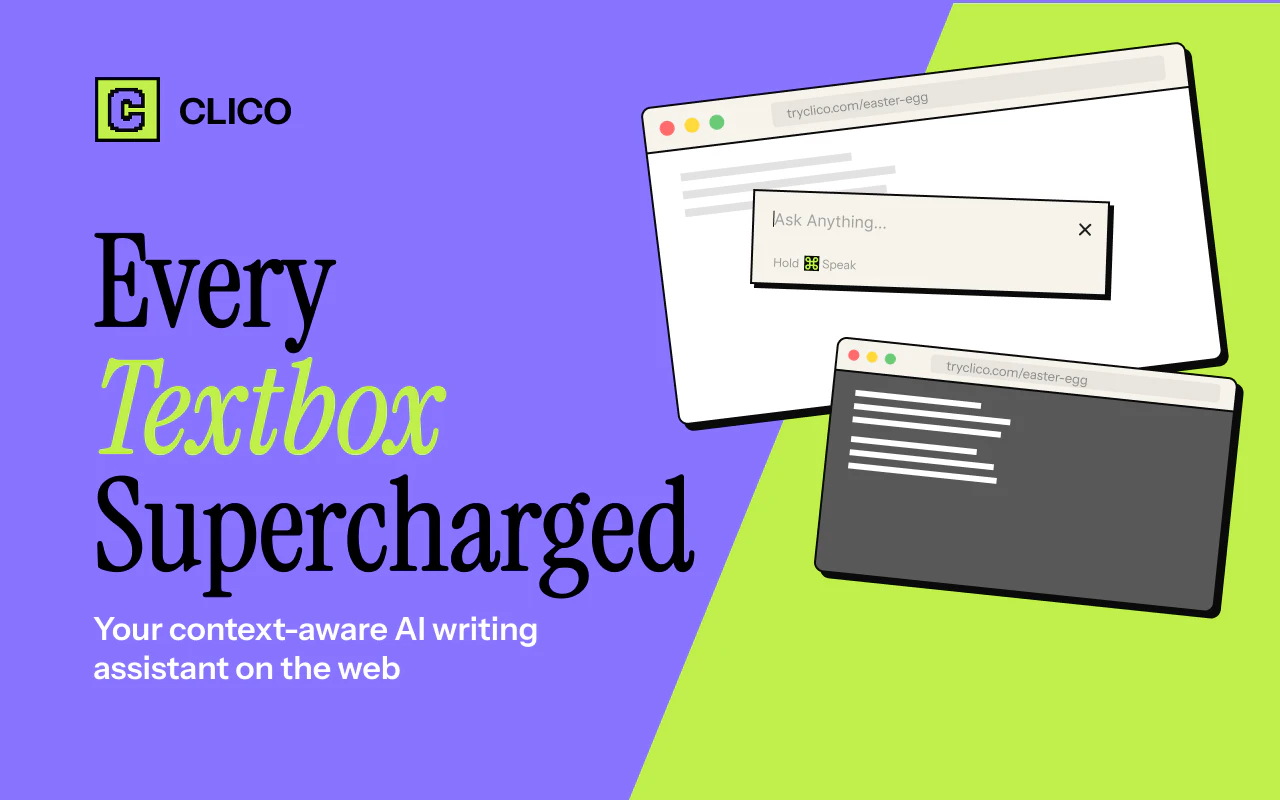
The core mechanic is simple. Press a keyboard shortcut and a Clico prompt window appears directly inside whatever text field you’re currently using. Not in a sidebar. Not in a separate tab. Inside the box. You can ask it to draft a reply, rewrite something, summarize the page you’re on, or ask a question about the content in front of you. The context-awareness piece is the differentiator they’re pitching hardest. Clico reportedly reads the page you’re on and uses that context to make its responses relevant rather than generic.
The supported surfaces list is genuinely broad. Google Docs, Gmail, Notion, Slack, Discord, LinkedIn, Reddit, Substack, Canva, Google Classroom. That’s not a curated set of power-user apps. That’s where people actually spend time.
There’s also a voice input feature, which puts it in proximity to tools like Sway that are trying to solve the same speed-of-thought problem from a different angle. Whether anyone uses the voice feature in a shared office or a coffee shop is a real question.
The product did well when it launched on Product Hunt, hitting the top daily spot.
What I’d want to poke at: the free tier with no API key requirement means Clico is absorbing model costs directly. That’s a deliberate call that lowers the signup barrier significantly, but it’s a model that eventually requires either a paid tier, usage limits, or outside capital. The founders listed on Crunchbase are Tomasz Rys and Janusz Jarosz, both listed as co-founders and co-owners. There’s no public funding information available, which makes the economics here genuinely opaque.
The product is clean. The promise is specific.
The Verdict: This Will Work for Six Months, Then Reality Hits
Clico is solving a real problem in a straightforward way. The copy-paste loop between your work surface and an AI tool is a legitimate tax on productivity, and putting the prompt directly inside the text field is the right architectural answer. The context-awareness angle, if it actually works consistently, is what separates this from a glorified keyboard shortcut.
But I need to be direct: Clico’s timing is both its greatest advantage and its fatal vulnerability. The product is good enough to get traction fast. The first 30 days will feel like validation. Early adopters will find the shortcut and use it. The retention numbers will probably look fine because the product actually solves a real friction point.
The problem emerges at 60 days. The free-with-no-API-key model is a Trojan horse. Either usage scales and costs become a real line item that kills the unit economics, or it doesn’t and the product is solving such a marginal problem that it can’t sustain a business. There is no middle path here. One founder I know called this the “extension graveyard spiral” and I think he’s right: great products that solve small problems for busy people eventually collide with the reality that busy people don’t pay for small solutions.
The real determinant of whether Clico exists in two years is not product quality or market timing. It’s whether they can get acquired before the free model becomes unsustainable. A larger AI company like Anthropic or even Google would probably want this integration layer. But Voilà and the rest of this field are not standing still, and acquisition windows close faster than founders think.
My prediction: Clico gets meaningful traction by Q3 2025, gets bought by a larger player before 2026 ends, or quietly dies as usage drifts downward and the founder realizes the business math doesn’t work. I’d genuinely want to be wrong about this.