














claude-code-channels-2
Push events and chat with Claude Code via Telegram & Discord
Anthropic Wants Your Phone to Be the New Terminal
The Macro: Why Mobile Visibility Into AI Agents Is the Real Unlock Everyone’s Missing
There’s a specific kind of developer anxiety that’s hard to explain to non-engineers. You kick off a long agentic job, close your laptop lid, go get lunch, and spend the whole time half-wondering if it hit an error three minutes after you left. You’re not glued to your desk, but you’re kind of glued to your desk. Nobody’s really solved this.
The AI coding assistant space has been moving fast. Claude Code, Cursor, Copilot, Devin, the list keeps growing. But most of these tools are still fundamentally desktop-first. You sit down, you type, you iterate. They’re good at that. What they’re bad at is the async case: the job running overnight, the multi-step agent that needs a human checkpoint, the build that silently fails while you’re in a meeting.
This matters more now because agents are actually doing longer work. The whole pitch of agentic coding in 2025 is that you delegate a task and come back. But coming back doesn’t work cleanly when you have no visibility into what’s happening in the middle. That’s the gap, and I think most people in this space are still treating it like a nice-to-have rather than a fundamental problem.
Mobile hasn’t really entered this picture in a meaningful way. Phones are where we live now. I check mine probably 80 times a day (don’t @ me). But they’re almost entirely absent from developer tooling conversations, which is weird given how much time developers spend not at a desk. The timing here feels right because we’ve finally reached the inflection point where agents can run long enough to justify the overhead. Cal.com is doing interesting work thinking about how AI agents fit into scheduling and async coordination, and similar logic applies here. The terminal shouldn’t be anchored to a desk anymore. It shouldn’t be.
The Micro: Texting Your Terminal Back
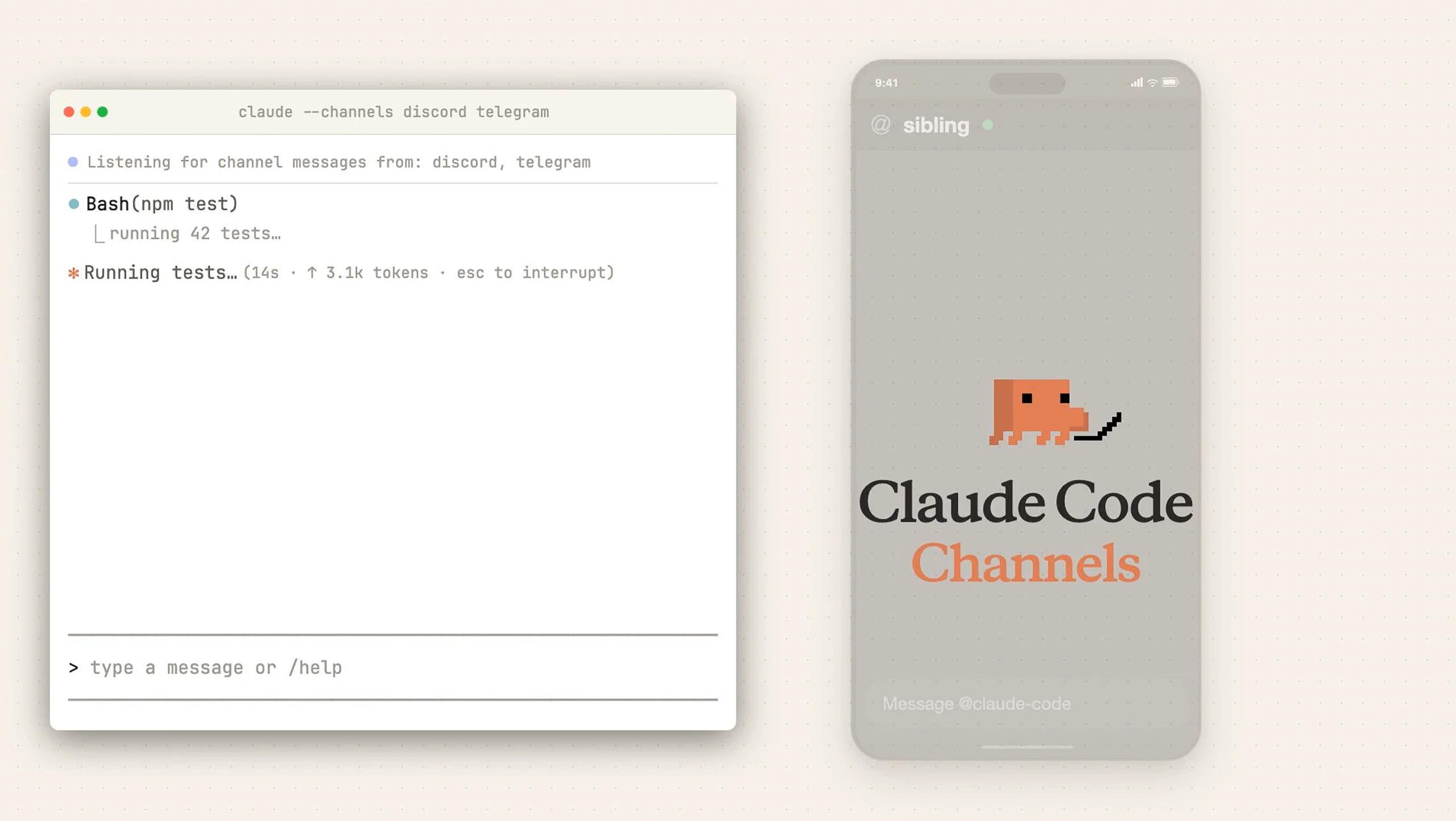
Here’s what it actually does. Claude Code Channels lets you bridge a running Claude Code session to Telegram or Discord using MCP (Model Context Protocol) servers. Once set up, your coding session can push events out to you, like notifications when something completes or errors out, and you can reply directly from your phone. That reply goes back into the terminal session as input. You’re essentially texting your coding agent.
The MCP server piece is the interesting implementation choice here. MCP is Anthropic’s protocol for connecting Claude to external tools and data sources, and using it as the bridge layer here means Channels plugs into the same infrastructure developers are already (slowly) building around. It’s not a one-off integration. It’s an extension of a thing they’re already committed to.
Starting with Telegram and Discord is smart, actually. These aren’t random picks. Telegram has a strong developer base, has a genuinely good bot API, and is already running in the background on a lot of engineers’ phones for community stuff. Discord is where a meaningful chunk of technical communities already live. These are apps that were already open. That lowers the friction to actually using this.
The interaction model is simple enough that I can picture it. You’ve got a Claude Code session running some refactoring job. It hits a decision point it can’t resolve without you. Instead of blocking or hallucinating its way through, it sends you a message. You reply from the couch. It continues. That’s the loop.
It got solid traction on launch day, which tracks. This is the kind of tool that devs immediately understand without needing a demo.
The missing details are mostly about reliability. I’d want to know what happens when the MCP server drops. Or when the Telegram message delivers but the session is already stale. Edge cases around async state are where tools like this fall apart quietly. Also, right now it’s Telegram and Discord. No SMS, no iMessage, no Slack (which is where a lot of people’s work notifications already live, per products like ReplylessAI that are betting on inbox-first workflows).
The Verdict: This Works, But Only If Anthropic Treats It Like a Platform, Not a Feature
I think this actually ships and sticks, but I’m going to sound like a skeptic to explain why.
The core insight is correct. Developers need visibility into async jobs. The messaging interface works better than people expect because it mimics how we already communicate about work. I can immediately think of three times last month when I would have wanted this, and that’s not performed enthusiasm.
But here’s what matters: this only becomes a habit if the setup cost approaches zero and the reliability approaches perfect. MCP-based tools have friction. Getting your servers connected, authenticating properly, handling rate limits across Telegram or Discord, managing secrets through a messaging interface. That’s not friction-free. Some users will bounce.
The real question is whether Anthropic doubles down and makes this a real platform with proper mobile clients, proper credential management, and native integrations. Or whether this stays a Telegram bot that feels clever for six months before people realize messaging isn’t the ideal UI for technical feedback loops.
I’m betting they lean into it. The 60-day signal will be community MCP servers. If developers start building their own, you’ve got something. If it’s still just Anthropic’s defaults, it’s a feature. The 90-day signal is whether they launch a real mobile app or stay bound to chat networks.
My prediction: Anthropic ships a proper mobile app within five months, and by the end of 2025, this becomes table stakes for any serious coding agent. The company that doesn’t let developers supervise async work from their phone will look backwards.